Build a Limit Order Book Simulator from Scratch
A production-grade, educational LOB simulator with matching engine, market impact, RL market makers, and real-data calibration.
Repo: github.com/satyamdas03/lumina-lob
Docs: satyamdas03.github.io/lumina-lob
Install: pip install lumina-lob
Why build another LOB simulator?
Limit order books are the invisible plumbing of modern markets. Every time you buy a stock, option, or crypto token, your order is matched inside an LOB. Yet most educational simulators are either too abstract or too small to capture the dynamics that matter at the tick level:
- Price-time priority and queue position.
- Adverse selection when informed traders trade against you.
- Inventory risk for market makers.
- Market impact and how temporary vs. permanent effects differ.
- Calibration to real tick data so simulations behave like actual markets.
I built Lumina LOB to bridge that gap. It is open-source, pip-installable, fully tested, and documented. This post walks through the design decisions, the code, and the lessons learned along the way.
What you will learn
- How a price-time priority matching engine works in Python.
- How to add realistic agents: noise traders, informed traders, and market makers.
- How to separate the fundamental price from the observed bid/ask.
- How to calibrate arrival rates, spreads, and impact from real Polygon/Databento data.
- How to train a reinforcement-learning market maker with Stable-Baselines3.
- Where the C++ speed-up layer fits and when it is worth it.
- How to visualize the book, history, and export replay GIFs/MP4s.
Price-time priority: the core matching rule
At its heart an LOB is two sorted queues:
- Bids sorted descending by price.
- Asks sorted ascending by price.
Within the same price, orders are served by arrival time: first-in-first-out. This is price-time priority. When a new order arrives, the engine checks whether it crosses the best price on the opposite side. If it does, it trades; if not, it rests.
Here is the whole engine in about twenty lines:
from lumina_lob import Order, OrderBook, MatchingEngine, Side

book = OrderBook()
engine = MatchingEngine(book)

# Resting bid for 10 shares at 100
engine.process(Order(1, Side.BID, 100, 10))

# Crossing ask for 4 shares at 100 — fills against the resting bid
engine.process(Order(2, Side.ASK, 100, 4))

print(book.trades)      # [(1, 2, 4)]
print(len(book))        # 6 shares still resting
The engine also supports IOC, FOK, cancel, and modify orders, which turns out to be essential for realistic agent behavior:
from lumina_lob import OrderType

# Immediate-or-Cancel: execute what you can, cancel the rest
engine.process(Order(3, Side.ASK, 100, 100, order_type=OrderType.IOC))
Building realistic agents
A simulator is only as good as its agents. Lumina includes four built-in agents:
- NoiseTrader — random liquidity demand, calibrated from real trade-size distributions.
- InformedTrader — trades directionally to simulate information arrival.
- MarketMaker — symmetric quotes around a reference price with inventory limits.
- SkewedMarketMaker — skews quotes based on inventory to manage risk.
Agents implement one simple method, act(reference_price, book), and return a list of orders:
from lumina_lob.agents import Agent, NoiseTrader, MarketMaker

sim = Simulation(
    agents=[
        NoiseTrader(arrival_rate=4.0, size_max=8, seed=1),
        MarketMaker(spread_half_width=2, quote_size=10, max_inventory=50),
    ],
    seed=42,
)
sim.run(n_steps=100)
print(sim.to_dataframe().head())
The Simulation orchestrator advances a reference price, asks every agent for orders, routes those orders through the matching engine, and records a step-by-step history DataFrame.
Separating fundamental price from observed prices
One early mistake is to let the mid price drift randomly. In real markets, there is a fundamental fair value and the observed bid/ask are quotes around it. Lumina separates these:
ReferencePriceProcess— a random-walk fundamental price.OrderBook— the actual resting orders.- Impact models — push the fundamental price when large trades arrive.
This separation makes it possible to study adverse selection: if an informed trader buys aggressively, the fundamental price rises, and a market maker that filled the sell side loses on average.
Market impact: propagator vs. Almgren-Chriss
Lumina implements two classic impact models:
- PropagatorImpact — temporary impact decays exponentially after each trade; permanent impact accumulates linearly.
- AlmgrenChrissImpact — splits each trade into permanent and temporary components with a decay parameter.
Both are fit from real trade data using the calibration helpers:
from lumina_lob.data import PolygonClient, calibrate

downloader = PolygonClient(api_key="YOUR_KEY")
trades = downloader.get_trades("AAPL", "2026-06-01")
quotes = downloader.get_daily_bars("AAPL", "2026-06-01", "2026-06-01")
params = calibrate(trades, quotes)
print(params.arrival_rate, params.permanent_impact, params.temporary_impact)
Calibration to real tick data
A simulator whose parameters are guessed is just a video game. Lumina can calibrate itself against real tick data:
calibrate_arrival_ratefrom inter-arrival times.calibrate_spreadfrom observed bid-ask spreads.calibrate_trade_sizefrom empirical size histograms.calibrate_impactfrom signed volume and price changes.
Data comes from Polygon.io or Databento via built-in downloaders. Once calibrated, you can replay historical quote/trade events through the engine and validate that simulated spreads match the real distribution.
from lumina_lob.data import ReplayEngine, validate_spread_distribution

replay = ReplayEngine(book, engine)
replay.run(df_events)
validate_spread_distribution(real_spreads, simulated_spreads)
Training an RL market maker
Market making is a classic RL problem: quote bid/ask offsets and sizes, receive fills, earn the spread, and penalize inventory risk. Lumina exposes a gymnasium environment and trains with stable-baselines3:
from lumina_lob.rl import MarketMakerEnv, train_ppo, save_model

env = MarketMakerEnv(seed=42)
model = train_ppo(env, total_timesteps=50_000)
save_model(model, "market_maker_ppo.zip")
The reward is the change in mark-to-market P&L minus a quadratic inventory penalty. The action space controls quote offsets around the reference price and the size to quote on each side. A trained PPO agent usually beats a naive symmetric market maker because it learns to skew quotes when inventory grows large.
C++ acceleration layer
Python is fast to write but not fast enough to simulate millions of events per second. Lumina includes an optional C++17 core bound via pybind11. The public API is identical:
from lumina_lob import _core  # optional compiled extension

book = _core.OrderBook()
engine = _core.MatchingEngine(book)
On a 200k-order stream on a consumer laptop, the pure-Python engine processes roughly 12k events/sec while the C++ engine reaches 54k events/sec (about 4x faster). Throughput varies with hardware, order mix, and whether the workload crosses the best bid/offer. The bigger win will come from a batch-submission API that keeps more work on the C++ side; that is on the roadmap.
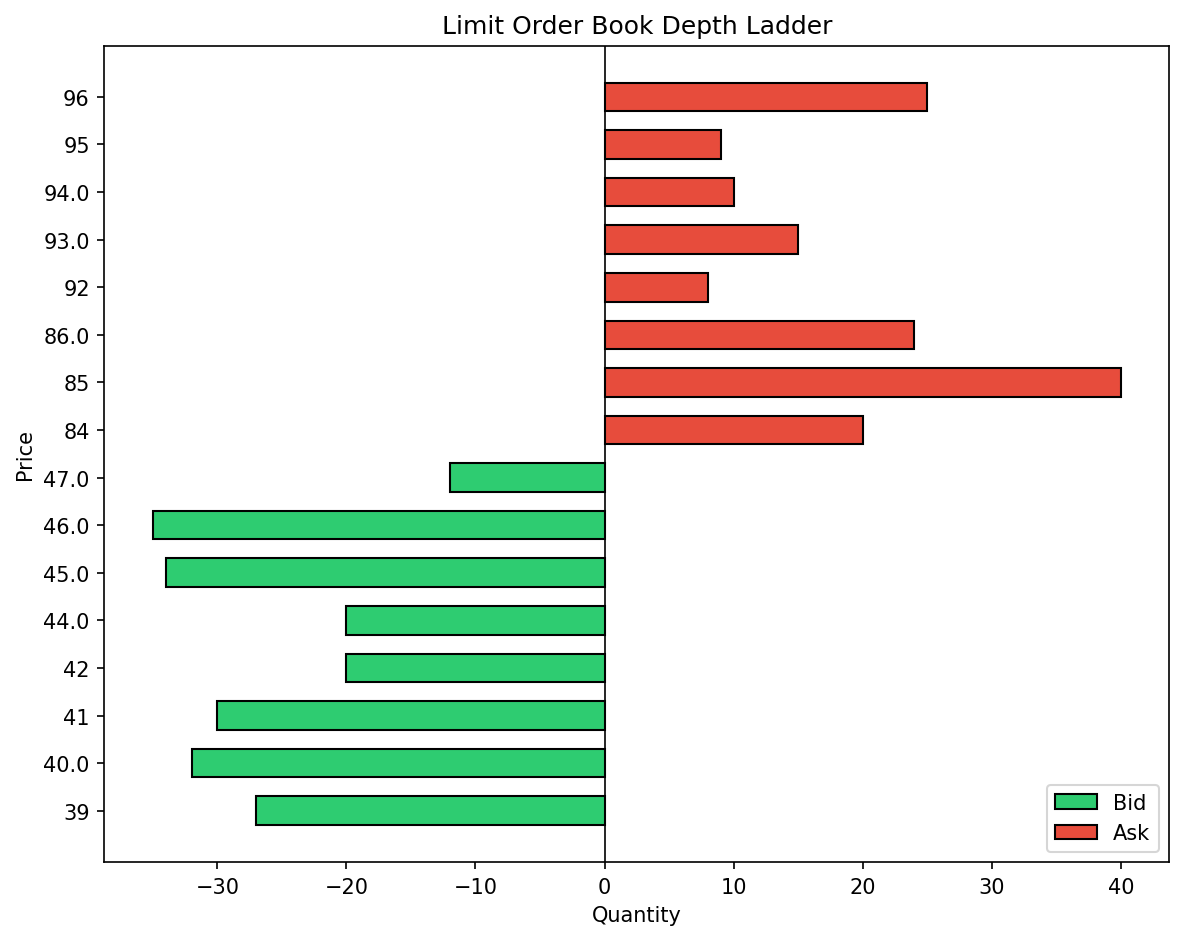
Visualization
Understanding an LOB from printed trades is hard. Lumina ships with Matplotlib visualizations:
Depth ladder — a snapshot of resting liquidity:
Simulation history — mid price, spread, and volume over time:
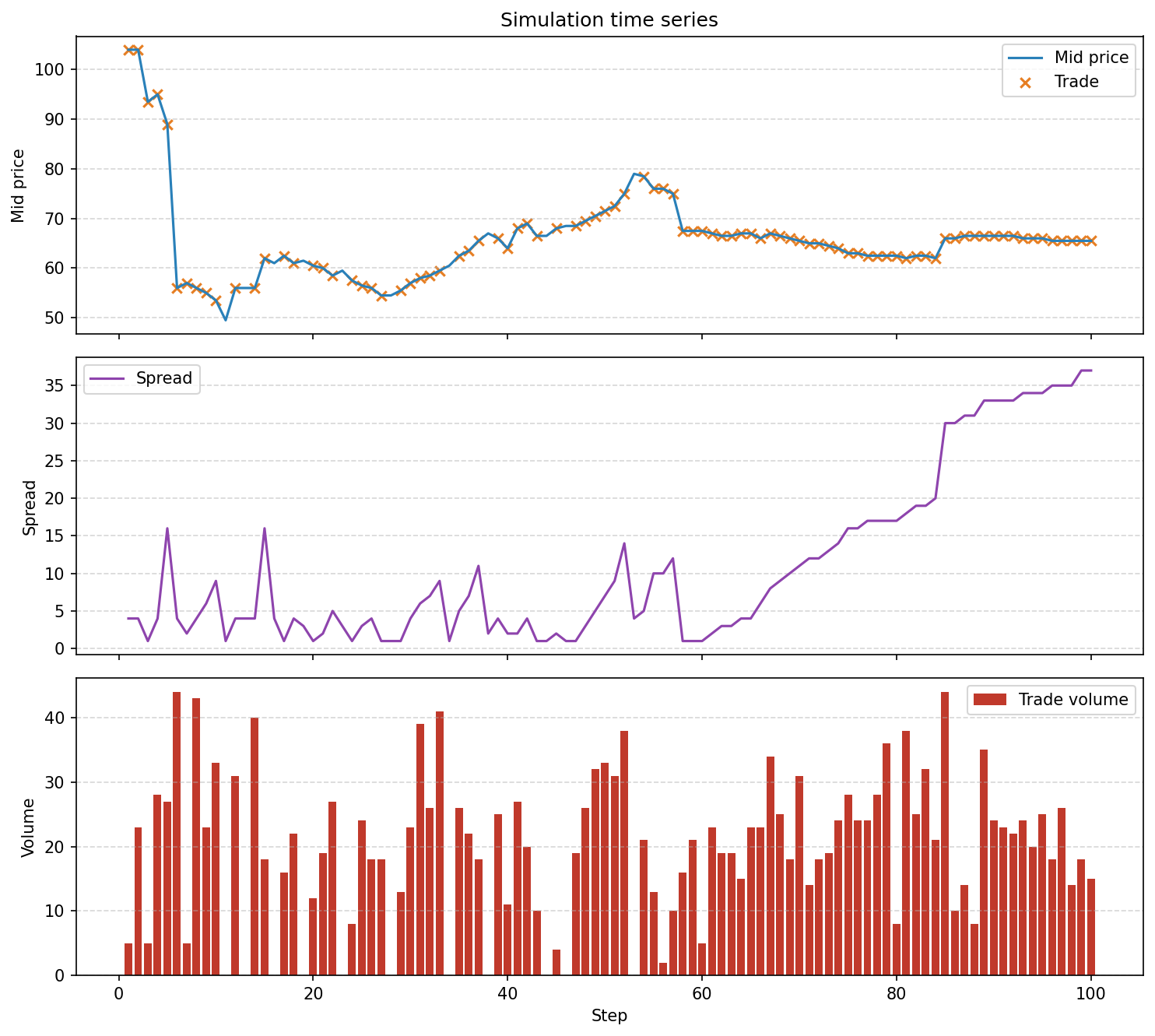
There is also a real-time animator and GIF/MP4 export for replay videos.
Lessons learned
- Separate the fundamental price from the book early. It makes adverse selection and impact modeling much cleaner.
- Agents must implement
on_fill. Without fill notifications, market makers cannot track inventory and will happily quote themselves into huge directional exposure. - Calibration is not optional. Guessed parameters produce toy markets. Real data grounds the simulator.
- Test the C++ path too. The Python and C++ engines must produce identical trades, otherwise the speed-up layer is silently wrong.
- 100% package coverage is worth it. When every branch is exercised, refactors stop being scary.
Try it yourself
from lumina_lob import Simulation
from lumina_lob.agents import NoiseTrader, MarketMaker

sim = Simulation(
    agents=[
        NoiseTrader(arrival_rate=5.0, size_max=10, seed=1),
        MarketMaker(spread_half_width=2, quote_size=10),
    ],
    seed=42,
)
sim.run(n_steps=200)
print(sim.to_dataframe().head())
The full source, docs, and notebooks are at github.com/satyamdas03/lumina-lob.
What is next?
- Publish this post on Medium / Dev.to and cross-post on LinkedIn.
- Pin the repository on my GitHub profile.
- Add a batch-submission API to push the C++ engine past 100k events/sec.
- Calibrate against additional tick datasets and publish a reproducible benchmark report.
If you are interviewing at a quant firm, studying market microstructure, or building an RL trading system, I hope Lumina LOB saves you a few weeks of boilerplate. Contributions and feedback are welcome.
Satyam Das · MIT License · Lumina LOB on GitHub